


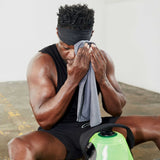
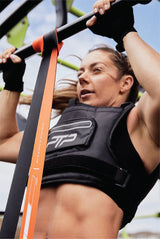



How Integrated Strengthwear Makes Every Move Work Harder
The Science Behind PTP Integrated Strengthwear
What if getting more from your workout didn’t mean changing your workout?
PTP Integrated Strengthwear integrates removable micro-weights into technical training apparel, distributing resistance over key muscle groups to increase the work your body does as you move.
The idea is simple: add resistance to the movement you’re already doing.
The micro-weights sit over the key muscle groups in your upper arms, thighs and calves, with the load spread across the limbs rather than concentrated on the joints. As you walk, run, train or play sport, those muscles have to work harder to move and control the added resistance, helping you get more from every move.
And that extra work is measurable. In testing, calories burned were up to 35% higher across the same session, while perceived effort remained comparable.⁴
And that extra work is measurable. In testing, calorie’s burned were up to 35% higher across the same session, while perceived effort remained comparable.⁴
What is Integrated Strengthwear?
Weighted vests, wrist and ankle weights introduced the idea of adding resistance to movement. Integrated Strengthwear takes that idea forward by integrating removable micro-weights into performance apparel and positioning them over the muscle belly, rather than concentrating the load at the joints.
Across the upper arms, thighs and calves, each weight sits close to the muscles driving the movement. The load is then distributed across the limbs so the garments work together as a complete wearable resistance system.
This is more than clothing with weight added. It is resistance engineered into what you wear.
Why muscle-belly placement matters.
Integrated Strengthwear’s design focuses on where the resistance sits and how it works with the body in motion.
Positioning the micro-weights over the major muscle areas adds resistance directly to where they work. This means that every step, swing and repetition requires your muscles to move and control the added load.
The product range provides options for distributing the load across different parts of the body, which means more total resistance can be created through multiple smaller weights, rather than carried in one place.
Does wearable resistance work?
Wearable resistance is backed by more than a decade of published research.
A peer-reviewed systematic review analysed 32 studies of wearable resistance across walking, running, sprinting and jumping. It found that strategically placed resistance can increase the metabolic and muscular demands of movement and create activity-specific overload.¹
Other peer-reviewed research has shown that adding mass to the legs increases the energy required for walking, while lower-leg wearable resistance increases oxygen consumption and heart rate during running.² ³ Together, the evidence shows that both the amount and position of resistance influence how much work the body performs.
To see whether the design of PTP Integrated Strengthwear translated into a measurable effect, participants completed the same walking and jogging activity with and without the calf-anchored limb-loading system (built to approximately 3% to 4% of body weight).
Wearing the PTP Integrated Strengthwear increased oxygen consumption, heart rate, ventilation and calorie expenditure. The strongest responders burned up to 35% more calories across the session and reached training intensity up to 74% faster, while perceived effort remained comparable at the higher measured intensity.⁴
The evidence points to the same conclusion: the position and distribution of resistance influence how demanding activity becomes. This is how Integrated Strengthwear has been engineered - to make the movement you already do work harder.
Which weighted strengthwear should you start with?
Start with the movement you want to get more from.
For walking and everyday movement, choose shorts with calf sleeves or leggings to spread resistance across the legs. Add a weighted top if you want to increase the workload across more of the body.
For running, cycling and lower-body conditioning, shorts with calf sleeves or leggings add resistance through repeated lower-body work, making every stride, pedal stroke or repetition more demanding.
For Yoga and Pilates leggings or calf sleeves add resistance through standing sequences, leg work and holds, while arm bands or arm sleeves can add resistance through upper-body movements and controlled repetitions.
In the gym, build the setup around your session. Shorts with calf sleeves or leggings add resistance through lower-body and compound exercises. A weighted top increases the workload across circuits and full-body exercises, while arm bands or sleeves make repeated push-and-pull exercises more demanding.
Sport-specific training calls for a more targeted setup. A weighted top, arm bands or sleeves add resistance to the rotation and upper-body effort behind a tennis serve or golf swing. Shorts and calf sleeves make acceleration, footwork and change-of-direction drills more demanding for soccer and basketball.
Resistance at the calves is a great place to start, you can then combine upper- and lower-body pieces and increase the load gradually as your training develops.
How much weight should you wear?
More weight isn't automatically better. The aim is to use enough resistance to increase the workload without changing the way you move.
In testing, the target was around 3% to 4% of body weight, spread across the moving limbs with the calves included as part of the setup. That's the loading range we recommend working towards.
Use the guide below to find your target load:
|
Body weight |
Target load (kg) |
|
50 to 65 kg (110 to 145 lb) |
1.5 to 2.6 kg |
|
65 to 85 kg (145 to 187 lb) |
1.9 to 3.4 kg |
|
85 to 105 kg (187 to 231 lb) |
2.5 to 4.1 kg |
If you weigh more than 105kg, the same 3% to 4% guide applies. Build towards your target using the limb pieces, with resistance at the calves included as part of the setup.
The removable micro-weights let you begin at the lighter end and progressively increase the resistance. Start with a lighter load and build gradually over your first few sessions. If the added resistance changes your form, reduce the load. If you want to add more load, the weighted vest can be layered on top to increase total workload.
Because the range is modular, you can combine different pieces to reach the load that suits your body and the way you train.
If you are new to exercise, returning after injury, pregnant, or managing a medical or mobility condition, seek advice from an appropriate healthcare professional before use.
Get more from every move
Better performance doesn’t always come from doing more. Sometimes it comes from making more of what you’re already doing.
PTP Integrated Strengthwear adds intelligently placed resistance to walking, running, training and sport, helping turn familiar movement into more effective training.
Same movement. More work. Get more from every move.
<SHOP THE RANGE>
References
-
Macadam P, Cronin J, Simperingham K. The effects of wearable resistance training on metabolic, kinematic and kinetic variables during walking, running, sprint running and jumping: a systematic review. Sports Medicine. 2017;47(5):887–906.
-
Browning RC, Modica JR, Kram R, Goswami A. The effects of adding mass to the legs on the energetics and biomechanics of walking. Medicine & Science in Sports & Exercise. 2007;39(3):515–525.
-
Field AP, Gill N, Uthoff AM, Plews DJ. Acute metabolic changes with lower leg-positioned wearable resistances during submaximal running in endurance-trained runners. Sports. 2019;7(10):220.
-
Willis A. How Much Weight Should You Wear? A Physical Therapist’s Guide. KILOGEAR, 2026. PTP Integrated Strengthwear is the KILOGEAR loading system described in this source and evaluated in the matched-condition testing cited in this article. Based on KILOGEAR matched-condition treadmill testing in which participants completed the same walking and jogging conditions with and without the distributed loading system. Based on acute single-session treadmill testing. Figures represent the strongest responders, not typical results. Individual results may vary.